|
|
 |
| |
|
| 15/11/2002 6:05:00 pm |
| QRS News Australia Issue No. 1, 2002 |
|
| We Test Drive the New QRS101 |
|
|
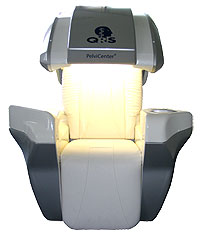
| Test driving the new QRS101 |
Research and development
QRS is the result of more than 20 years of fundamental and applied research by leading international scientists and engineers. With seven years of commercial experience and more than 35,000 units in the field worldwide, it is not surprising that the new QRS101 is cutting edge technology in the realm of energy medicine.
Professor Linus Pauling, the double Nobel Prize winning scientist, is quoted in Body Electric (the defining book on electromagnetics by the equally famous Dr. Robert Becker) as saying ? QRS will lead to a paradigm change in medicine?.
The wave-form, frequencies, amplitude window and method of application of this pulsed electromagnetic field technology is the core of the QRS worldwide patents. A technology update occurred in mid-2001 with the release of the control unit fitted for biofeedback (patented). Simultaneously, Professor Dr. Manfred Krauss changed the QRS signal in a very small way to speed up the ?unclumping? of the red blood cells (see Page 5, May 2001 Newsletter). Professor Krauss has worked with many patients who have advanced complications from diabetes and his exhaustive clinical research led to this change.
With the new QRS101, the core signal remains untouched. What has been added is a great deal more sophistication and flexibility without compromising the simplicity of use that has been a feature of QRS.
|
|
| The control unit console |
|
|
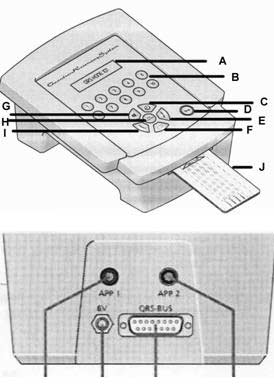
| The new control unit is robust with clean new lines |
Aesthetically, the new control unit has been modernised with soft lines. It is grey in colour and it has a robust feel to it. It will clearly stand the little knocks and bumps that happen over time.
The new control unit is robust with clean new lines
A Multi-function Display
B Setting of field strength (10 settings)
C Therapy duration
D Stop / Off
E Sensitive Program
F Applicator select (eg. mat, pillow, pen)
G Sound ON/OFF
H Appliance switch-on / program selection
(includes Basis, Vital and Relax programs)
I Memo ? program setting
J Home card (programmable) memory
The control unit?s touch-pad is simple and easy to read. I found that resting the box on its side made the controls more readily accessible when lying in bed with the control unit placed on a bedside table. It didn?t look out of place and it was stable.
The rear view of the control unit
The Applicators (Mat, Pillow, Pen, etc.) plug into the two RCA jacks at the rear of the control unit. The manufacturer has reverted to the ?gold plug?. It is not a difficult task to replace the ?black? plugs for anyone wanting to upgrade to the new control unit. Toggling between applicators is carried out from the front panel.
There is a 15 pin male plug (called a ?bus?) on the back of the control unit for future accessories, believed to include a feedback device (February 2002), a light shower and soft laser. Who knows what other health management accessories the scientists will present next. At least they have made provision for their dreams to become reality.
LCD screen ? control unit
When the On Program button is pressed, the LCD screen lights up. It is a good-sized screen with large, bright numbers and letters. All information is displayed on this screen.
When a therapy is running, the LCD shows therapy settings, the polarity alternating with the applicator chosen (eg. > then 1) and the duration counts down to zero in minutes and seconds.
Pressure sensitive switches
Importantly, the layout of the touch-pad is simple and logical. In my travels through Europe and Asia on the way home with the sample QRS, I made a point of putting QRS on the hotel bed and trying to operate it in the dark. After a few minutes I could feel the shape of the raised switches and I could set the desired therapy.
Function buttons
The QRS101 is full of functionality without having a myriad of switches/buttons:
ON PROGRAM button has the following functions:
·Turn the system on
·Select the Basis program
·Select the Vital program
·Select the Relax program
DURATION button allows selection of therapy times from 1 minute to 60 minutes. If the button is not pushed the default is 8 minutes.
SENSITIVE button provides a therapy using the basis program that is only 300 nano Tesla, one tenth of the intensity of the former QRS setting one. From tens of thousands of QRS users it has been found that about 3% of people find QRS too strong even on setting one so this will be a great benefit to those people. The sensitive program will also provide better results with Parkinson?s disease, some neurological diseases and multiple chemical sensitivity (detoxification).
APPLICATOR button, when pressed, switches between fitted applicators. There are two jacks on the back of the control unit so two applicators can be installed but only one can be used at a time.
MEMO button allows you to:
·Repeat the therapy last used
·Program the smart card
·Load a program saved from the smart card
SOUND button allows you to play the tones at the end of a therapy or be silent. For the many people who want to have a silent therapy during the night, this will be a welcome addition.
STOP button:
·Stops the therapy if in progress
·Turns the control unit off
·If not pressed after a therapy, the control unit will switch off automatically after two minutes of inaction. This is very convenient, especially with a fairly bright LCD screen.
Start- up
When the On Program button is pressed from the off position, the LCD screen lights up and the control unit does a systems check. It detects what applicators are installed (mat, pillow, pen etc) and it will tell you if, for example, Applicator 2 does not have an applicator fitted. It then reports system OK. You are then asked to please select. You can now decide on your next selection of therapy.
Selecting a therapy
A therapy runs when you press one of the intensity buttons 1 ? 10. The default therapy is the Basis Program and it runs for 8 minutes duration. |
|
| The difference between programs |
|
|
| |
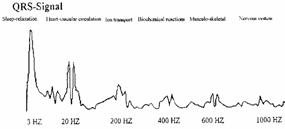
The graphic above shows the full QRS signal including frequencies from 0.1Hz to 1,000Hz. This is the basis of remedial therapy.
The QRS scientists have divided the Basis program into two parts focussing on specific frequencies and micro-pulse intervals to create specialized programs. The actual frequencies and pulse timings are highly confidential intellectual property that the scientists are keeping to themselves (because QRS is being copied). Frankly, neither the user nor the practitioner need know the fine detail ? only the indications treated. The new programs are:
·Relax program (10 levels of intensity). This is the para-sympathetic nervous system program. Enhanced results will be obtained in the areas of relaxation, immune system stimulation, reduction of sleep disorders and reduction of the symptoms of stress. Settings 5 to 10 can only be accessed through programming of a Doctor?s (Smart) Card. If one of these buttons is pushed, [MAXIMUM 04] displays.
·Vital program (10 levels of intensity).
This is the nitrogen monoxide activation program. Enhanced results will be obtained for peripheral blood circulation disorders, coronary heart disease, thrombosis, high blood pressure, headaches, psoriasis, erectile dysfunction, endothelium dysfunction, sensitivity to weather changes and vitality.
Selecting a more complex therapy
The touch-pad is easy to use and experimenting can?t do any harm. Let us explore a few therapy examples from the ?Please Select? status:
·Morning. I want to use the Mat applicator on the basis program, setting 4, for 12 minutes with the sound on. Press the sound button to on. Press the duration button to 12 minutes. Press setting 4. There is no need to select the Basis program because it is the default program.
·Osteoarthritis therapy. I now want to treat my knee for 24 minutes with the Pillow applicator on setting 6, Basis program. Press the duration button to 24 minutes. Press the applicator button to Applicator 2. Press setting 6. As the sound was selected for the previous therapy there is no need to press the sound button.
·Mid-day. I feel tired after lunch and need to energise myself. I select the Mat applicator on the Vital program for 10 minutes on setting 8. Press the On button until the Vital program displays. Press the Duration button to 10 minutes. Press setting 8.
·Evening. I want to really relax and experience tells me that the Relax program on setting 2 for 12 minutes will put me to sleep. Push the On button to Relax program. Press the Duration to 12 minutes. Press the Sound button to Off. Then press setting 2.
·Repeat therapy. I am too active tonight. I need to repeat the previous therapy. Press Memo. The previous therapy is in memory and it will re-run.
Memo and the smart card
The QRS 101 has a smart card reader and writer. This is a very significant technological advancement that has immediate application and will become more important as healthcare practitioners are equipped with the highly capable Professional Model QRS (during 2002).
The QRS is delivered with one blank Smart Card. The card is just like the SIM card in a mobile phone. It is a memory card and the computer chip is clearly visible. Insert it into the card slot in the front panel of the control unit in the direction of the arrow on the card. The screen will display ?home card? for a few seconds and please select.
The Smart Card can memorise four programs and there is space on the card to write notes about each of the programs. Programs can be written over and we understand from the engineers that the card has a long life.
Programming is simple. Hold down the Memo button for 2 seconds ? SAVE [1-4] displays. Press 1. You can now input your program by pushing the function buttons (ON/Program, Duration, Sound, etc). The last button pushed must be the setting button (the signal to complete the program). The therapy will now run. You can stop the therapy at any time by pushing the stop button once.
To run your individualised therapy, insert the card and press Memo 1. Once the therapy is running, the Card can be removed or stored in the unit.
Future of the smart card
In 2002, healthcare practitioners will be able to design optimum therapies that are written to a Smart Card, using a near infrared diagnostic device delivered as a module to the QRS Professional Device. Clients will be able to take the card home and use it as prescribed therapy with individualized frequencies and intensities.
Power adaptor
The transformer has been taken out of the control unit and placed on the wall plug. This removes any suggestion of electro-smog away from the control unit. The transformer is now multi-voltage (110-240 Volt) and it can be used in any country by simply attaching an adaptor to suit the country?s pin configuration.
Mat and pillow applicators
The mat and pillow applicators are lighter and don?t come with a vinyl cover. The colour is grey and the QRS logo is printed into the fabric. There is a need to protect the surface from soiling and cotton sheeting material is ideal. We can provide such a cover as an accessory. We have been notified that the mat applicator will soon be made 5 centimetres narrower. This will make it easier to fit the mat on therapy tables.
Warranty
Our company has always provided a five-year warranty on QRS sold in Australia whereas the European warranty has only been two years. The German manufacturer has agreed to maintain the 5-year warranty for countries in which our company is involved in marketing. We anticipate as few problems with the new QRS as we have had with the current one ? almost zero defects.
Conclusion
It is a pleasure to test-drive a technology that is well-engineered and manufactured, that is easy to use, flexible and has provision for future accessories and peripherals. The 20+ new therapy options will lead to improved health benefits for QRS clients and this is the aim. Roll on QRS101, ?go you good thing!? |
|
| Published by Stewart Penny, 15/11/2002 6:05:00 pm (). |
| |
|
|
|
|
|
|
|
| Tip a friend about this article! |
|
|
|
|
|
Novato Medic AB | Unnebo 1, S-335 33 Gnosjö, Sweden | Tel:
+46 370-33 36 75, Fax: +46 370-33 36 76
E-mail:
novato@qrs.nu |
|